
Curatorial Snapshot. By: REM Escobar.
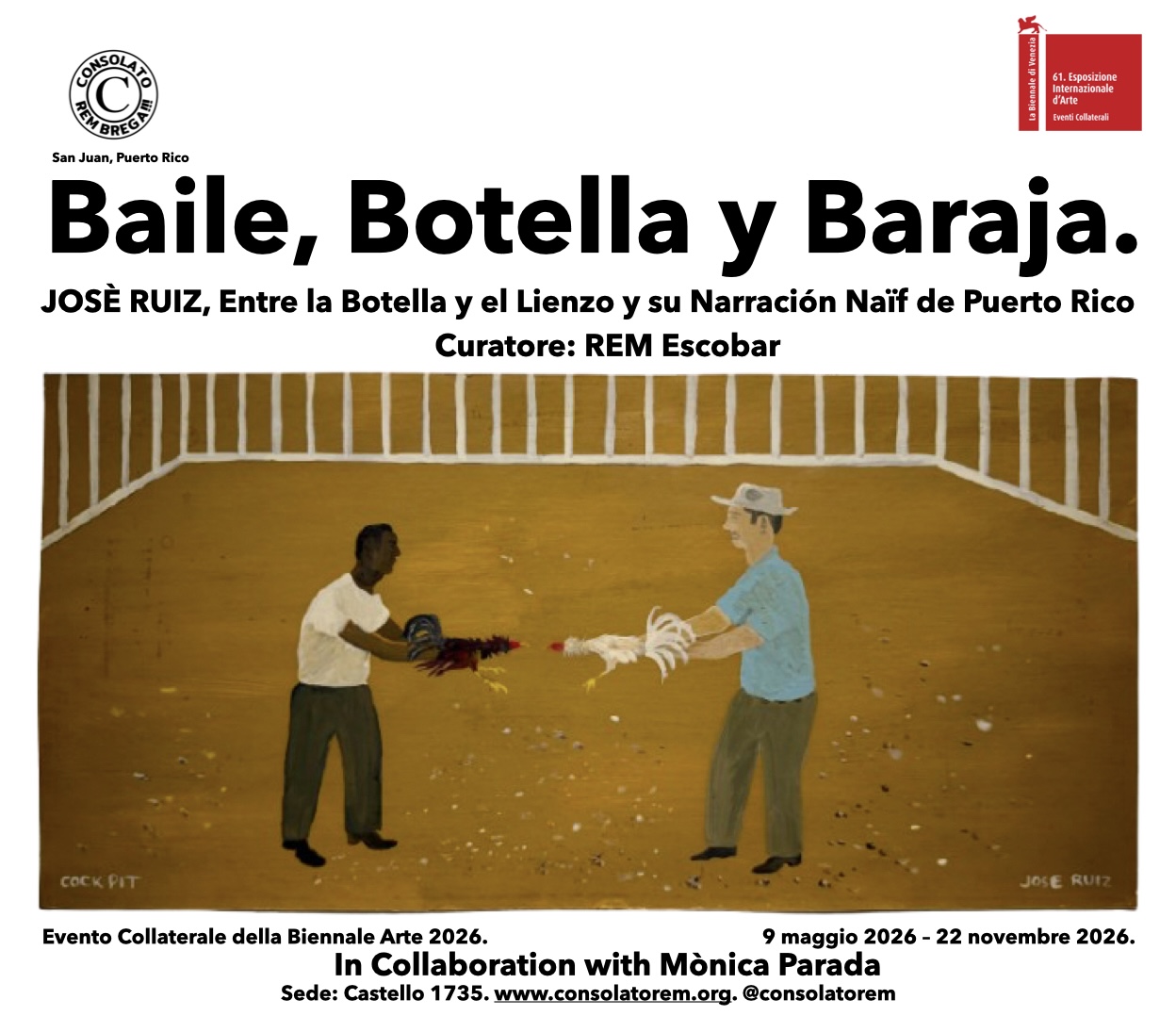
BAILE, BOTELLA Y BARAJA. Jose Ruiz entre la Botella y el lienzo y su narración naïf de Puerto Rico The project Baile, Botella y Baraja situates the work of Puerto Rican painter José Ruiz (1936–2015) as a visual archive that, through a naïf aesthetic, condenses the colonial and contemporary history of the Caribbean. Ruiz rejects academic painting to build a pedagogy of the popular: carnivals, fairs, plazas, and hearths appear as settings where everyday life records centuries of violence and resistance. His naïf is not naivety, but a form of counter-memory that restores centrality to what the canon renders invisible. During the pre-opening days, the exhibition will be activated through the Cards & Domino Tournament, a participatory program incorporating sculptural tables and performance by Puerto Rican artist Mónica Parada, integrating Caribbean social practices such as card playing, dominoes, music, and dance within the context of the Biennale di Venezia. Ruiz’s canvases unfold a temporal arc that connects 16th-century mining exploitation and the encomienda system—with figures as eloquent as the 667,647 pesos of gold extracted between 1510 and 1519 under forced labor—to the drastic demographic reduction of the Taíno, the importation of enslaved Africans after the 1518 Asiento, and the resistance led by figures such as Yuiza (c.1500–1519), the only documented cacica. That foundational violence is transformed, over time, into culture: carnivals, vejigante masks, bomba, and plena emerge as forms of survival and aesthetic re-signification. The title of the exhibition also recalls the famous governing formula of Miguel de la Torre (1823–1837) —“baile, botella y baraja”— applied in Puerto Rico as a colonial policy of social control. What in the 19th century was a demagogic strategy inspired by panem et circenses becomes, in Ruiz’s painting, a cultural grammar: a poetics in which festivity ceases to be an instrument of alienation and becomes a memory of resistance. Ruiz’s narration also dialogues with major figures in Puerto Rican history: Betances, Lola Rodríguez de Tió, Albizu Campos, Mariana Bracetti, Julia de Burgos, Luisa Capetillo, José de Diego, and Roberto Clemente, among others. His pictorial archive intertwines episodes of oppression and emancipation: from the contraceptive pill clinical trials conducted by the United States in Río Piedras, Puerto Rico (1955–1956)—which placed the female body at the center of colonial biopolitics—to the 2019 protests, when Puerto Rican youth transformed indignation into music, performance, and combative perreo, leading to the resignation of Governor Ricardo Rosselló. Along this path, Ruiz’s canvases function as visual scores that keep memory alive in minor keys, showing how popular culture turns violence into creativity and marginality into archive. In Venice, the project activates his work through a multimedia installation that interlaces image and sound—from bomba to perreo—reinforcing its condition as a living archive. Baile, Botella y Baraja thus proposes to situate José Ruiz within the international debate not only as a naïf artist but as a historical narrator of Puerto Rico: a creator who transformed oppression into celebration, and whose work demonstrates that festivity is also pedagogy, and memory, a space of resistance.
 CURATORIAL TEXT
By: REM Escobar
As part of the official program of collateral events of the 60th Venice Biennale, the exhibition Baile, Botella y Baraja. José Ruiz, Entre el Lienzo y la Botella y su Narraciòn Naïf de Puerto Rico is presented within the curatorial framework In Minor Keys. This exhibition brings together a selection of paintings by the artist alongside a digital installation that intertwines his images with Puerto Rican popular music —perreo—, expanding its sensorial and political reach. It marks the second participation of the Consolato REM Brega in the Biennale, and proposes a dialogue between the intimate and the historical, the festive and the subaltern.
During the pre-opening days, the exhibition will be activated through the Cards & Domino Tournament, a participatory program incorporating sculptural tables and performance by Puerto Rican artist Mónica Parada, integrating Caribbean social practices such as card playing, dominoes, music, and dance within the context of the Biennale di Venezia.
In this context, the work of the naïf artist José Ruiz (1936–2017) becomes a powerful visual counter-memory, where the everyday acquires the weight of archive and celebration reveals itself as a form of cultural resistance.
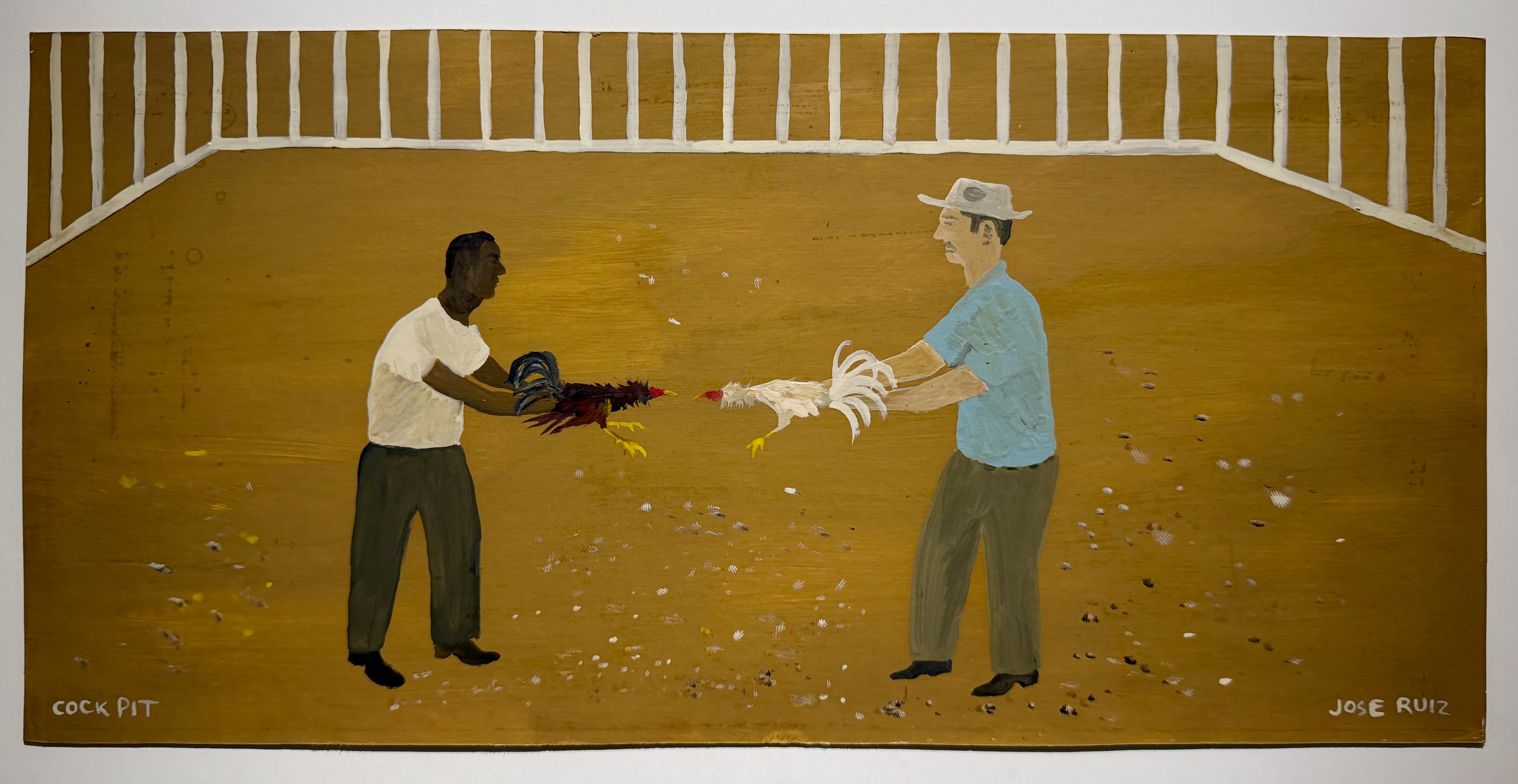
To speak of José Ruiz (1936–2017) is to speak of a naïf narrator who, between the bottle and the canvas, constructed a visual chronicle of Puerto Rico over six decades. His work, seemingly ingenuous, is in fact a strategy of memory: a pictorial writing where the popular becomes archive and the everyday becomes pedagogy. Baile, Botella y Baraja is not just a title; it is a cultural grammar that organizes the life of the people around three axes —celebration, play, and resistance.
Ruiz’s naïf style is not the product of technical naivety, but of a political decision: renouncing academic virtuosity in order to focus the gaze on what the canon renders invisible. Each bottle, deck of cards, or dance is a sign laden with history. The fairs, plazas, carnivals, and hearths he portrays are not mere costumbrista scenes, but exercises in counter-memory. What appears festive on the surface reveals layers of historical violence transformed into creativity.
The history of Puerto Rico runs through his canvases like a underlying bassline. The gold exploitation of the 16th century and the encomienda system, which decimated the Taíno population; the systematic importation of enslaved Africans after the Asiento of 1518; the rebellions of cimarrones in the mountains; and figures such as Yuiza, Taíno “cacica”(Woman Chief) and symbol of resistance, form the backdrop of that memory. What was once pain, epidemic, and violence was transformed over time into hybrid expressions: vejigante masks, carnival processions, Afro-Caribbean rhythms, and community festivals. Ruiz captures these legacies in a minor key, recording how the subaltern converts oppression into culture.
Between 1510 and 1519, 667,647 pesos of gold were produced in Puerto Rico under the encomienda system. In 1519 alone, 139,078 pesos were extracted, reflecting the intensity of exploitation. The Taíno population suffered a drastic decline due to forced labor, armed conflict, and epidemics —especially the smallpox outbreak of 1518–1519, which killed approximately one-third of the Indigenous population. In response to this demographic crisis, the colonizers implemented the first Asiento of 1518, through which at least 767 enslaved Africans were brought between 1519 and 1523, consolidating a society based on extraction and structural violence.
In the same period, the figure of Yuiza (c.1500–c.1519) stands out as the only documented female cacica. Born around 1500 and captured in 1519, she led the defense of her community against Spanish colonization. Her story demonstrates that Taíno resistance was neither linear nor exclusively male, and links the first struggles with the later arrival of enslaved Africans and the construction of an Afro-Caribbean identity.
To speak of Baile, Botella y Baraja in Puerto Rico is also to recall Miguel de la Torre y Pando (1786–1843), a Spanish military officer who fought in the War of Independence and was later defeated by independence forces in the Battle of Carabobo (1821) against Simón Bolívar. He arrived in Puerto Rico in December 1823 to serve as governor and captain general until 1837, becoming the colonial official with the longest mandate on the island. Appointed with the aim of preventing what had occurred in Venezuela and New Granada from happening in Puerto Rico, he applied his famous governing strategy known as “baile, botella y baraja,” inspired by the Roman logic of panem et circenses: keeping the people entertained and distracted to prevent uprisings. With his intendant José Domingo Díaz, he strengthened the repressive apparatus (laborer booklets, censorship, espionage) while simultaneously promoting popular festivities, games, and alcohol as tools of social control, consolidating colonial order while expanding sugar production and infrastructure. Although he retired in 1837 and died in Madrid in 1843, his political philosophy of distracting the people with entertainment remains alive to this day in Puerto Rico, where the culture of vacilón, mass music, and the entertainment industry have often functioned as a safety valve postponing reflection and protest in the face of structural crises such as public debt, agreements with investors and bondholders, the intervention of the Fiscal Oversight Board, or mass emigration. The “demagogic genius” of De la Torre remains relevant: from the Roman circus to Bad Bunny’s concerts in San Juan, the formula of power has been clear —while the people laugh, dance, and consume, those who govern postpone solutions to deeper problems.
Ruiz’s dialogue is not limited to the immediately popular. His scenes resonate with the heroes and cultural figures who wove the island’s identity: Ramón Emeterio Betances and the Grito de Lares, Lola Rodríguez de Tió and La Borinqueña, Pedro Albizu Campos and the nationalist struggle, Mariana Bracetti and the first flag, Julia de Burgos and the poetry of social justice, Roberto Clemente and the ethics of humanism, intertwined with other essential names such as José de Diego, poet and independence advocate, and Luisa Capetillo, pioneer of feminism and the labor movement. Ruiz shares with them the ability to transform everyday experience into historical narrative.
Critic José Antonio Pérez Ruiz (1941–2023) synthesizes this force by noting that in José Ruiz’s work, “past and future converge in a dynamism where the popular becomes living memory.” Although the artist passed away in 2015, his paintings remain alive, resonating with the collective energy of Puerto Rico. The statement is crucial: his canvases are not illustrations of a dead yesterday, but a moving archive. In them, community becomes a language of resistance. Thus, when the protests of the summer of 2019, which culminated in the resignation of Governor Ricardo Rosselló, transformed indignation into music, performance, and collective dance, they were not painted by Ruiz but echoed the same cultural forms—bottle, baraja, carnival—that he had long depicted. His work shows that these traditions, deeply rooted in Puerto Rican life, have always been modes of cultural resistance.
Ruiz’s naïf must be understood as a politics of form. In contrast to academic painting, which canonizes heroes or solemn scenes, Ruiz chooses to depict card games, markets, bottles, and carnivals. The apparent simplicity is a tactic of radical clarity: to show that the history of a people is also written from the ordinary. In this, he dialogues with global references such as Henri Rousseau in France or Grandma Moses in the United States, but distinguishes himself radically from both. Rousseau imagined exotic jungles from postcards; Moses reconstructed American pastoral nostalgia; Ruiz, on the other hand, documents the vibrant complexity of an island shaped by colonization, slavery, and mestizaje. His naïf is not evasion, but denunciation in popular form.Recent history also traverses the memory of bodies. Between 1955 and 1956, Puerto Rico was the site of the contraceptive pill trials (Puerto Rico Pill Trials), conducted in neighborhoods such as Río Piedras under the supervision of Dr. Edris Rice-Wray. Puerto Rican women participated under risky conditions, yet demonstrated agency and autonomy, connecting with the tradition of resistance that Ruiz celebrates in his work.
Today, Ruiz’s work takes on new meaning on contemporary platforms. His canvases, animated in multimedia installations, become a living archive that connects with digital generations and global audiences. What was once oil on canvas now unfolds as a visual score in motion, expanding its pedagogical reach and showing that Puerto Rico’s cultural memory is not fixed in a closed past but is reinvented in continuous present.
Baile, Botella y Baraja is, ultimately, a visual, political, and educational project that synthesizes the history of Puerto Rico. Each bottle and each gesture reveal how a people has transformed violence into memory, marginality into resistance, and pain into celebration. José Ruiz emerges as the naïf narrator of the island: an artist who chose whisper over rhetoric, and who inscribed in color the living history of Puerto Rico.
In Venice, his voice will resonate beyond the local: reminding us that the most enduring stories are not always those told in solemn halls, but those transmitted in the rhythms of community life, in the echo of drums, in the cards dealt at the table, and in the dances that, generation after generation, have sustained the memory of a people.
Ruiz’s canvases unfold a temporal arc that connects 16th-century mining exploitation and the encomienda system —with figures as telling as the 667,647 pesos of gold extracted between 1510 and 1519 under forced labor— with the drastic demographic decline of the Taíno, the importation of enslaved Africans after the Asiento of 1518, and the resistance led by figures such as Yuiza (c.1500–1519), the only documented cacica. This foundational violence is transformed, over time, into culture: carnivals, vejigante masks, bomba and plena emerge as forms of survival and aesthetic resignification.
The exhibition’s title also recovers the famous governing formula of Miguel de la Torre (1823–1837) —“baile, botella y baraja”— applied in Puerto Rico as a colonial policy of social control. What in the 19th century was a demagogic strategy inspired by panem et circenses, in Ruiz’s painting becomes cultural grammar: a poetics where festivity ceases to be an instrument of alienation and becomes a memory of resistance.
Ruiz’s narrative also dialogues with the great figures of Puerto Rican history: Betances, Lola Rodríguez de Tió, Albizu Campos, Mariana Bracetti, Julia de Burgos, Luisa Capetillo, José de Diego, and Roberto Clemente, among others. His pictorial archive links episodes of oppression and emancipation: from the contraceptive pill clinical trials carried out by the United States in Río Piedras, Puerto Rico (1955–1956), which placed the female body at the center of colonial biopolitics, to the protests of 2019, when Puerto Rican youth transformed indignation into music, performance, and combative perreo, leading to the resignation of Governor Ricardo Rosselló.
In this trajectory, Ruiz’s canvases function as visual scores that keep memory alive in minor keys, showing how popular culture turns violence into creativity, and marginality into archive. In Venice, the proposal activates his work through a multimedia installation that intertwines image and sound —from bomba to perreo— reinforcing its condition as a living archive.
Baile, Botella y Baraja thus proposes to position José Ruiz in the international debate not only as a naïve artist, but as a historical narrator of Puerto Rico: a creator who transformed oppression into celebration, and whose work demonstrates that festivity is also pedagogy and memory, a space of resistance.
Meet: Mónica Parada
CURATORIAL TEXT
By: REM Escobar
As part of the official program of collateral events of the 60th Venice Biennale, the exhibition Baile, Botella y Baraja. José Ruiz, Entre el Lienzo y la Botella y su Narraciòn Naïf de Puerto Rico is presented within the curatorial framework In Minor Keys. This exhibition brings together a selection of paintings by the artist alongside a digital installation that intertwines his images with Puerto Rican popular music —perreo—, expanding its sensorial and political reach. It marks the second participation of the Consolato REM Brega in the Biennale, and proposes a dialogue between the intimate and the historical, the festive and the subaltern.
During the pre-opening days, the exhibition will be activated through the Cards & Domino Tournament, a participatory program incorporating sculptural tables and performance by Puerto Rican artist Mónica Parada, integrating Caribbean social practices such as card playing, dominoes, music, and dance within the context of the Biennale di Venezia.
In this context, the work of the naïf artist José Ruiz (1936–2017) becomes a powerful visual counter-memory, where the everyday acquires the weight of archive and celebration reveals itself as a form of cultural resistance.
To speak of José Ruiz (1936–2017) is to speak of a naïf narrator who, between the bottle and the canvas, constructed a visual chronicle of Puerto Rico over six decades. His work, seemingly ingenuous, is in fact a strategy of memory: a pictorial writing where the popular becomes archive and the everyday becomes pedagogy. Baile, Botella y Baraja is not just a title; it is a cultural grammar that organizes the life of the people around three axes —celebration, play, and resistance.
Ruiz’s naïf style is not the product of technical naivety, but of a political decision: renouncing academic virtuosity in order to focus the gaze on what the canon renders invisible. Each bottle, deck of cards, or dance is a sign laden with history. The fairs, plazas, carnivals, and hearths he portrays are not mere costumbrista scenes, but exercises in counter-memory. What appears festive on the surface reveals layers of historical violence transformed into creativity.
The history of Puerto Rico runs through his canvases like a underlying bassline. The gold exploitation of the 16th century and the encomienda system, which decimated the Taíno population; the systematic importation of enslaved Africans after the Asiento of 1518; the rebellions of cimarrones in the mountains; and figures such as Yuiza, Taíno “cacica”(Woman Chief) and symbol of resistance, form the backdrop of that memory. What was once pain, epidemic, and violence was transformed over time into hybrid expressions: vejigante masks, carnival processions, Afro-Caribbean rhythms, and community festivals. Ruiz captures these legacies in a minor key, recording how the subaltern converts oppression into culture.
Between 1510 and 1519, 667,647 pesos of gold were produced in Puerto Rico under the encomienda system. In 1519 alone, 139,078 pesos were extracted, reflecting the intensity of exploitation. The Taíno population suffered a drastic decline due to forced labor, armed conflict, and epidemics —especially the smallpox outbreak of 1518–1519, which killed approximately one-third of the Indigenous population. In response to this demographic crisis, the colonizers implemented the first Asiento of 1518, through which at least 767 enslaved Africans were brought between 1519 and 1523, consolidating a society based on extraction and structural violence.
In the same period, the figure of Yuiza (c.1500–c.1519) stands out as the only documented female cacica. Born around 1500 and captured in 1519, she led the defense of her community against Spanish colonization. Her story demonstrates that Taíno resistance was neither linear nor exclusively male, and links the first struggles with the later arrival of enslaved Africans and the construction of an Afro-Caribbean identity.
To speak of Baile, Botella y Baraja in Puerto Rico is also to recall Miguel de la Torre y Pando (1786–1843), a Spanish military officer who fought in the War of Independence and was later defeated by independence forces in the Battle of Carabobo (1821) against Simón Bolívar. He arrived in Puerto Rico in December 1823 to serve as governor and captain general until 1837, becoming the colonial official with the longest mandate on the island. Appointed with the aim of preventing what had occurred in Venezuela and New Granada from happening in Puerto Rico, he applied his famous governing strategy known as “baile, botella y baraja,” inspired by the Roman logic of panem et circenses: keeping the people entertained and distracted to prevent uprisings. With his intendant José Domingo Díaz, he strengthened the repressive apparatus (laborer booklets, censorship, espionage) while simultaneously promoting popular festivities, games, and alcohol as tools of social control, consolidating colonial order while expanding sugar production and infrastructure. Although he retired in 1837 and died in Madrid in 1843, his political philosophy of distracting the people with entertainment remains alive to this day in Puerto Rico, where the culture of vacilón, mass music, and the entertainment industry have often functioned as a safety valve postponing reflection and protest in the face of structural crises such as public debt, agreements with investors and bondholders, the intervention of the Fiscal Oversight Board, or mass emigration. The “demagogic genius” of De la Torre remains relevant: from the Roman circus to Bad Bunny’s concerts in San Juan, the formula of power has been clear —while the people laugh, dance, and consume, those who govern postpone solutions to deeper problems.
Ruiz’s dialogue is not limited to the immediately popular. His scenes resonate with the heroes and cultural figures who wove the island’s identity: Ramón Emeterio Betances and the Grito de Lares, Lola Rodríguez de Tió and La Borinqueña, Pedro Albizu Campos and the nationalist struggle, Mariana Bracetti and the first flag, Julia de Burgos and the poetry of social justice, Roberto Clemente and the ethics of humanism, intertwined with other essential names such as José de Diego, poet and independence advocate, and Luisa Capetillo, pioneer of feminism and the labor movement. Ruiz shares with them the ability to transform everyday experience into historical narrative.
Critic José Antonio Pérez Ruiz (1941–2023) synthesizes this force by noting that in José Ruiz’s work, “past and future converge in a dynamism where the popular becomes living memory.” Although the artist passed away in 2015, his paintings remain alive, resonating with the collective energy of Puerto Rico. The statement is crucial: his canvases are not illustrations of a dead yesterday, but a moving archive. In them, community becomes a language of resistance. Thus, when the protests of the summer of 2019, which culminated in the resignation of Governor Ricardo Rosselló, transformed indignation into music, performance, and collective dance, they were not painted by Ruiz but echoed the same cultural forms—bottle, baraja, carnival—that he had long depicted. His work shows that these traditions, deeply rooted in Puerto Rican life, have always been modes of cultural resistance.
Ruiz’s naïf must be understood as a politics of form. In contrast to academic painting, which canonizes heroes or solemn scenes, Ruiz chooses to depict card games, markets, bottles, and carnivals. The apparent simplicity is a tactic of radical clarity: to show that the history of a people is also written from the ordinary. In this, he dialogues with global references such as Henri Rousseau in France or Grandma Moses in the United States, but distinguishes himself radically from both. Rousseau imagined exotic jungles from postcards; Moses reconstructed American pastoral nostalgia; Ruiz, on the other hand, documents the vibrant complexity of an island shaped by colonization, slavery, and mestizaje. His naïf is not evasion, but denunciation in popular form.Recent history also traverses the memory of bodies. Between 1955 and 1956, Puerto Rico was the site of the contraceptive pill trials (Puerto Rico Pill Trials), conducted in neighborhoods such as Río Piedras under the supervision of Dr. Edris Rice-Wray. Puerto Rican women participated under risky conditions, yet demonstrated agency and autonomy, connecting with the tradition of resistance that Ruiz celebrates in his work.
Today, Ruiz’s work takes on new meaning on contemporary platforms. His canvases, animated in multimedia installations, become a living archive that connects with digital generations and global audiences. What was once oil on canvas now unfolds as a visual score in motion, expanding its pedagogical reach and showing that Puerto Rico’s cultural memory is not fixed in a closed past but is reinvented in continuous present.
Baile, Botella y Baraja is, ultimately, a visual, political, and educational project that synthesizes the history of Puerto Rico. Each bottle and each gesture reveal how a people has transformed violence into memory, marginality into resistance, and pain into celebration. José Ruiz emerges as the naïf narrator of the island: an artist who chose whisper over rhetoric, and who inscribed in color the living history of Puerto Rico.
In Venice, his voice will resonate beyond the local: reminding us that the most enduring stories are not always those told in solemn halls, but those transmitted in the rhythms of community life, in the echo of drums, in the cards dealt at the table, and in the dances that, generation after generation, have sustained the memory of a people.
Ruiz’s canvases unfold a temporal arc that connects 16th-century mining exploitation and the encomienda system —with figures as telling as the 667,647 pesos of gold extracted between 1510 and 1519 under forced labor— with the drastic demographic decline of the Taíno, the importation of enslaved Africans after the Asiento of 1518, and the resistance led by figures such as Yuiza (c.1500–1519), the only documented cacica. This foundational violence is transformed, over time, into culture: carnivals, vejigante masks, bomba and plena emerge as forms of survival and aesthetic resignification.
The exhibition’s title also recovers the famous governing formula of Miguel de la Torre (1823–1837) —“baile, botella y baraja”— applied in Puerto Rico as a colonial policy of social control. What in the 19th century was a demagogic strategy inspired by panem et circenses, in Ruiz’s painting becomes cultural grammar: a poetics where festivity ceases to be an instrument of alienation and becomes a memory of resistance.
Ruiz’s narrative also dialogues with the great figures of Puerto Rican history: Betances, Lola Rodríguez de Tió, Albizu Campos, Mariana Bracetti, Julia de Burgos, Luisa Capetillo, José de Diego, and Roberto Clemente, among others. His pictorial archive links episodes of oppression and emancipation: from the contraceptive pill clinical trials carried out by the United States in Río Piedras, Puerto Rico (1955–1956), which placed the female body at the center of colonial biopolitics, to the protests of 2019, when Puerto Rican youth transformed indignation into music, performance, and combative perreo, leading to the resignation of Governor Ricardo Rosselló.
In this trajectory, Ruiz’s canvases function as visual scores that keep memory alive in minor keys, showing how popular culture turns violence into creativity, and marginality into archive. In Venice, the proposal activates his work through a multimedia installation that intertwines image and sound —from bomba to perreo— reinforcing its condition as a living archive.
Baile, Botella y Baraja thus proposes to position José Ruiz in the international debate not only as a naïve artist, but as a historical narrator of Puerto Rico: a creator who transformed oppression into celebration, and whose work demonstrates that festivity is also pedagogy and memory, a space of resistance.
Meet: Mónica Parada
 CURATORIAL TEXT
By: REM Escobar
As part of the official program of collateral events of the 60th Venice Biennale, the exhibition Baile, Botella y Baraja. José Ruiz, Entre el Lienzo y la Botella y su Narraciòn Naïf de Puerto Rico is presented within the curatorial framework In Minor Keys. This exhibition brings together a selection of paintings by the artist alongside a digital installation that intertwines his images with Puerto Rican popular music —perreo—, expanding its sensorial and political reach. It marks the second participation of the Consolato REM Brega in the Biennale, and proposes a dialogue between the intimate and the historical, the festive and the subaltern.
During the pre-opening days, the exhibition will be activated through the Cards & Domino Tournament, a participatory program incorporating sculptural tables and performance by Puerto Rican artist Mónica Parada, integrating Caribbean social practices such as card playing, dominoes, music, and dance within the context of the Biennale di Venezia.
In this context, the work of the naïf artist José Ruiz (1936–2017) becomes a powerful visual counter-memory, where the everyday acquires the weight of archive and celebration reveals itself as a form of cultural resistance.
To speak of José Ruiz (1936–2017) is to speak of a naïf narrator who, between the bottle and the canvas, constructed a visual chronicle of Puerto Rico over six decades. His work, seemingly ingenuous, is in fact a strategy of memory: a pictorial writing where the popular becomes archive and the everyday becomes pedagogy. Baile, Botella y Baraja is not just a title; it is a cultural grammar that organizes the life of the people around three axes —celebration, play, and resistance.
Ruiz’s naïf style is not the product of technical naivety, but of a political decision: renouncing academic virtuosity in order to focus the gaze on what the canon renders invisible. Each bottle, deck of cards, or dance is a sign laden with history. The fairs, plazas, carnivals, and hearths he portrays are not mere costumbrista scenes, but exercises in counter-memory. What appears festive on the surface reveals layers of historical violence transformed into creativity.
The history of Puerto Rico runs through his canvases like a underlying bassline. The gold exploitation of the 16th century and the encomienda system, which decimated the Taíno population; the systematic importation of enslaved Africans after the Asiento of 1518; the rebellions of cimarrones in the mountains; and figures such as Yuiza, Taíno “cacica”(Woman Chief) and symbol of resistance, form the backdrop of that memory. What was once pain, epidemic, and violence was transformed over time into hybrid expressions: vejigante masks, carnival processions, Afro-Caribbean rhythms, and community festivals. Ruiz captures these legacies in a minor key, recording how the subaltern converts oppression into culture.
Between 1510 and 1519, 667,647 pesos of gold were produced in Puerto Rico under the encomienda system. In 1519 alone, 139,078 pesos were extracted, reflecting the intensity of exploitation. The Taíno population suffered a drastic decline due to forced labor, armed conflict, and epidemics —especially the smallpox outbreak of 1518–1519, which killed approximately one-third of the Indigenous population. In response to this demographic crisis, the colonizers implemented the first Asiento of 1518, through which at least 767 enslaved Africans were brought between 1519 and 1523, consolidating a society based on extraction and structural violence.
In the same period, the figure of Yuiza (c.1500–c.1519) stands out as the only documented female cacica. Born around 1500 and captured in 1519, she led the defense of her community against Spanish colonization. Her story demonstrates that Taíno resistance was neither linear nor exclusively male, and links the first struggles with the later arrival of enslaved Africans and the construction of an Afro-Caribbean identity.
To speak of Baile, Botella y Baraja in Puerto Rico is also to recall Miguel de la Torre y Pando (1786–1843), a Spanish military officer who fought in the War of Independence and was later defeated by independence forces in the Battle of Carabobo (1821) against Simón Bolívar. He arrived in Puerto Rico in December 1823 to serve as governor and captain general until 1837, becoming the colonial official with the longest mandate on the island. Appointed with the aim of preventing what had occurred in Venezuela and New Granada from happening in Puerto Rico, he applied his famous governing strategy known as “baile, botella y baraja,” inspired by the Roman logic of panem et circenses: keeping the people entertained and distracted to prevent uprisings. With his intendant José Domingo Díaz, he strengthened the repressive apparatus (laborer booklets, censorship, espionage) while simultaneously promoting popular festivities, games, and alcohol as tools of social control, consolidating colonial order while expanding sugar production and infrastructure. Although he retired in 1837 and died in Madrid in 1843, his political philosophy of distracting the people with entertainment remains alive to this day in Puerto Rico, where the culture of vacilón, mass music, and the entertainment industry have often functioned as a safety valve postponing reflection and protest in the face of structural crises such as public debt, agreements with investors and bondholders, the intervention of the Fiscal Oversight Board, or mass emigration. The “demagogic genius” of De la Torre remains relevant: from the Roman circus to Bad Bunny’s concerts in San Juan, the formula of power has been clear —while the people laugh, dance, and consume, those who govern postpone solutions to deeper problems.
Ruiz’s dialogue is not limited to the immediately popular. His scenes resonate with the heroes and cultural figures who wove the island’s identity: Ramón Emeterio Betances and the Grito de Lares, Lola Rodríguez de Tió and La Borinqueña, Pedro Albizu Campos and the nationalist struggle, Mariana Bracetti and the first flag, Julia de Burgos and the poetry of social justice, Roberto Clemente and the ethics of humanism, intertwined with other essential names such as José de Diego, poet and independence advocate, and Luisa Capetillo, pioneer of feminism and the labor movement. Ruiz shares with them the ability to transform everyday experience into historical narrative.
Critic José Antonio Pérez Ruiz (1941–2023) synthesizes this force by noting that in José Ruiz’s work, “past and future converge in a dynamism where the popular becomes living memory.” Although the artist passed away in 2015, his paintings remain alive, resonating with the collective energy of Puerto Rico. The statement is crucial: his canvases are not illustrations of a dead yesterday, but a moving archive. In them, community becomes a language of resistance. Thus, when the protests of the summer of 2019, which culminated in the resignation of Governor Ricardo Rosselló, transformed indignation into music, performance, and collective dance, they were not painted by Ruiz but echoed the same cultural forms—bottle, baraja, carnival—that he had long depicted. His work shows that these traditions, deeply rooted in Puerto Rican life, have always been modes of cultural resistance.
Ruiz’s naïf must be understood as a politics of form. In contrast to academic painting, which canonizes heroes or solemn scenes, Ruiz chooses to depict card games, markets, bottles, and carnivals. The apparent simplicity is a tactic of radical clarity: to show that the history of a people is also written from the ordinary. In this, he dialogues with global references such as Henri Rousseau in France or Grandma Moses in the United States, but distinguishes himself radically from both. Rousseau imagined exotic jungles from postcards; Moses reconstructed American pastoral nostalgia; Ruiz, on the other hand, documents the vibrant complexity of an island shaped by colonization, slavery, and mestizaje. His naïf is not evasion, but denunciation in popular form.Recent history also traverses the memory of bodies. Between 1955 and 1956, Puerto Rico was the site of the contraceptive pill trials (Puerto Rico Pill Trials), conducted in neighborhoods such as Río Piedras under the supervision of Dr. Edris Rice-Wray. Puerto Rican women participated under risky conditions, yet demonstrated agency and autonomy, connecting with the tradition of resistance that Ruiz celebrates in his work.
Today, Ruiz’s work takes on new meaning on contemporary platforms. His canvases, animated in multimedia installations, become a living archive that connects with digital generations and global audiences. What was once oil on canvas now unfolds as a visual score in motion, expanding its pedagogical reach and showing that Puerto Rico’s cultural memory is not fixed in a closed past but is reinvented in continuous present.
Baile, Botella y Baraja is, ultimately, a visual, political, and educational project that synthesizes the history of Puerto Rico. Each bottle and each gesture reveal how a people has transformed violence into memory, marginality into resistance, and pain into celebration. José Ruiz emerges as the naïf narrator of the island: an artist who chose whisper over rhetoric, and who inscribed in color the living history of Puerto Rico.
In Venice, his voice will resonate beyond the local: reminding us that the most enduring stories are not always those told in solemn halls, but those transmitted in the rhythms of community life, in the echo of drums, in the cards dealt at the table, and in the dances that, generation after generation, have sustained the memory of a people.
Ruiz’s canvases unfold a temporal arc that connects 16th-century mining exploitation and the encomienda system —with figures as telling as the 667,647 pesos of gold extracted between 1510 and 1519 under forced labor— with the drastic demographic decline of the Taíno, the importation of enslaved Africans after the Asiento of 1518, and the resistance led by figures such as Yuiza (c.1500–1519), the only documented cacica. This foundational violence is transformed, over time, into culture: carnivals, vejigante masks, bomba and plena emerge as forms of survival and aesthetic resignification.
The exhibition’s title also recovers the famous governing formula of Miguel de la Torre (1823–1837) —“baile, botella y baraja”— applied in Puerto Rico as a colonial policy of social control. What in the 19th century was a demagogic strategy inspired by panem et circenses, in Ruiz’s painting becomes cultural grammar: a poetics where festivity ceases to be an instrument of alienation and becomes a memory of resistance.
Ruiz’s narrative also dialogues with the great figures of Puerto Rican history: Betances, Lola Rodríguez de Tió, Albizu Campos, Mariana Bracetti, Julia de Burgos, Luisa Capetillo, José de Diego, and Roberto Clemente, among others. His pictorial archive links episodes of oppression and emancipation: from the contraceptive pill clinical trials carried out by the United States in Río Piedras, Puerto Rico (1955–1956), which placed the female body at the center of colonial biopolitics, to the protests of 2019, when Puerto Rican youth transformed indignation into music, performance, and combative perreo, leading to the resignation of Governor Ricardo Rosselló.
In this trajectory, Ruiz’s canvases function as visual scores that keep memory alive in minor keys, showing how popular culture turns violence into creativity, and marginality into archive. In Venice, the proposal activates his work through a multimedia installation that intertwines image and sound —from bomba to perreo— reinforcing its condition as a living archive.
Baile, Botella y Baraja thus proposes to position José Ruiz in the international debate not only as a naïve artist, but as a historical narrator of Puerto Rico: a creator who transformed oppression into celebration, and whose work demonstrates that festivity is also pedagogy and memory, a space of resistance.
Meet: Mónica Parada
CURATORIAL TEXT
By: REM Escobar
As part of the official program of collateral events of the 60th Venice Biennale, the exhibition Baile, Botella y Baraja. José Ruiz, Entre el Lienzo y la Botella y su Narraciòn Naïf de Puerto Rico is presented within the curatorial framework In Minor Keys. This exhibition brings together a selection of paintings by the artist alongside a digital installation that intertwines his images with Puerto Rican popular music —perreo—, expanding its sensorial and political reach. It marks the second participation of the Consolato REM Brega in the Biennale, and proposes a dialogue between the intimate and the historical, the festive and the subaltern.
During the pre-opening days, the exhibition will be activated through the Cards & Domino Tournament, a participatory program incorporating sculptural tables and performance by Puerto Rican artist Mónica Parada, integrating Caribbean social practices such as card playing, dominoes, music, and dance within the context of the Biennale di Venezia.
In this context, the work of the naïf artist José Ruiz (1936–2017) becomes a powerful visual counter-memory, where the everyday acquires the weight of archive and celebration reveals itself as a form of cultural resistance.
To speak of José Ruiz (1936–2017) is to speak of a naïf narrator who, between the bottle and the canvas, constructed a visual chronicle of Puerto Rico over six decades. His work, seemingly ingenuous, is in fact a strategy of memory: a pictorial writing where the popular becomes archive and the everyday becomes pedagogy. Baile, Botella y Baraja is not just a title; it is a cultural grammar that organizes the life of the people around three axes —celebration, play, and resistance.
Ruiz’s naïf style is not the product of technical naivety, but of a political decision: renouncing academic virtuosity in order to focus the gaze on what the canon renders invisible. Each bottle, deck of cards, or dance is a sign laden with history. The fairs, plazas, carnivals, and hearths he portrays are not mere costumbrista scenes, but exercises in counter-memory. What appears festive on the surface reveals layers of historical violence transformed into creativity.
The history of Puerto Rico runs through his canvases like a underlying bassline. The gold exploitation of the 16th century and the encomienda system, which decimated the Taíno population; the systematic importation of enslaved Africans after the Asiento of 1518; the rebellions of cimarrones in the mountains; and figures such as Yuiza, Taíno “cacica”(Woman Chief) and symbol of resistance, form the backdrop of that memory. What was once pain, epidemic, and violence was transformed over time into hybrid expressions: vejigante masks, carnival processions, Afro-Caribbean rhythms, and community festivals. Ruiz captures these legacies in a minor key, recording how the subaltern converts oppression into culture.
Between 1510 and 1519, 667,647 pesos of gold were produced in Puerto Rico under the encomienda system. In 1519 alone, 139,078 pesos were extracted, reflecting the intensity of exploitation. The Taíno population suffered a drastic decline due to forced labor, armed conflict, and epidemics —especially the smallpox outbreak of 1518–1519, which killed approximately one-third of the Indigenous population. In response to this demographic crisis, the colonizers implemented the first Asiento of 1518, through which at least 767 enslaved Africans were brought between 1519 and 1523, consolidating a society based on extraction and structural violence.
In the same period, the figure of Yuiza (c.1500–c.1519) stands out as the only documented female cacica. Born around 1500 and captured in 1519, she led the defense of her community against Spanish colonization. Her story demonstrates that Taíno resistance was neither linear nor exclusively male, and links the first struggles with the later arrival of enslaved Africans and the construction of an Afro-Caribbean identity.
To speak of Baile, Botella y Baraja in Puerto Rico is also to recall Miguel de la Torre y Pando (1786–1843), a Spanish military officer who fought in the War of Independence and was later defeated by independence forces in the Battle of Carabobo (1821) against Simón Bolívar. He arrived in Puerto Rico in December 1823 to serve as governor and captain general until 1837, becoming the colonial official with the longest mandate on the island. Appointed with the aim of preventing what had occurred in Venezuela and New Granada from happening in Puerto Rico, he applied his famous governing strategy known as “baile, botella y baraja,” inspired by the Roman logic of panem et circenses: keeping the people entertained and distracted to prevent uprisings. With his intendant José Domingo Díaz, he strengthened the repressive apparatus (laborer booklets, censorship, espionage) while simultaneously promoting popular festivities, games, and alcohol as tools of social control, consolidating colonial order while expanding sugar production and infrastructure. Although he retired in 1837 and died in Madrid in 1843, his political philosophy of distracting the people with entertainment remains alive to this day in Puerto Rico, where the culture of vacilón, mass music, and the entertainment industry have often functioned as a safety valve postponing reflection and protest in the face of structural crises such as public debt, agreements with investors and bondholders, the intervention of the Fiscal Oversight Board, or mass emigration. The “demagogic genius” of De la Torre remains relevant: from the Roman circus to Bad Bunny’s concerts in San Juan, the formula of power has been clear —while the people laugh, dance, and consume, those who govern postpone solutions to deeper problems.
Ruiz’s dialogue is not limited to the immediately popular. His scenes resonate with the heroes and cultural figures who wove the island’s identity: Ramón Emeterio Betances and the Grito de Lares, Lola Rodríguez de Tió and La Borinqueña, Pedro Albizu Campos and the nationalist struggle, Mariana Bracetti and the first flag, Julia de Burgos and the poetry of social justice, Roberto Clemente and the ethics of humanism, intertwined with other essential names such as José de Diego, poet and independence advocate, and Luisa Capetillo, pioneer of feminism and the labor movement. Ruiz shares with them the ability to transform everyday experience into historical narrative.
Critic José Antonio Pérez Ruiz (1941–2023) synthesizes this force by noting that in José Ruiz’s work, “past and future converge in a dynamism where the popular becomes living memory.” Although the artist passed away in 2015, his paintings remain alive, resonating with the collective energy of Puerto Rico. The statement is crucial: his canvases are not illustrations of a dead yesterday, but a moving archive. In them, community becomes a language of resistance. Thus, when the protests of the summer of 2019, which culminated in the resignation of Governor Ricardo Rosselló, transformed indignation into music, performance, and collective dance, they were not painted by Ruiz but echoed the same cultural forms—bottle, baraja, carnival—that he had long depicted. His work shows that these traditions, deeply rooted in Puerto Rican life, have always been modes of cultural resistance.
Ruiz’s naïf must be understood as a politics of form. In contrast to academic painting, which canonizes heroes or solemn scenes, Ruiz chooses to depict card games, markets, bottles, and carnivals. The apparent simplicity is a tactic of radical clarity: to show that the history of a people is also written from the ordinary. In this, he dialogues with global references such as Henri Rousseau in France or Grandma Moses in the United States, but distinguishes himself radically from both. Rousseau imagined exotic jungles from postcards; Moses reconstructed American pastoral nostalgia; Ruiz, on the other hand, documents the vibrant complexity of an island shaped by colonization, slavery, and mestizaje. His naïf is not evasion, but denunciation in popular form.Recent history also traverses the memory of bodies. Between 1955 and 1956, Puerto Rico was the site of the contraceptive pill trials (Puerto Rico Pill Trials), conducted in neighborhoods such as Río Piedras under the supervision of Dr. Edris Rice-Wray. Puerto Rican women participated under risky conditions, yet demonstrated agency and autonomy, connecting with the tradition of resistance that Ruiz celebrates in his work.
Today, Ruiz’s work takes on new meaning on contemporary platforms. His canvases, animated in multimedia installations, become a living archive that connects with digital generations and global audiences. What was once oil on canvas now unfolds as a visual score in motion, expanding its pedagogical reach and showing that Puerto Rico’s cultural memory is not fixed in a closed past but is reinvented in continuous present.
Baile, Botella y Baraja is, ultimately, a visual, political, and educational project that synthesizes the history of Puerto Rico. Each bottle and each gesture reveal how a people has transformed violence into memory, marginality into resistance, and pain into celebration. José Ruiz emerges as the naïf narrator of the island: an artist who chose whisper over rhetoric, and who inscribed in color the living history of Puerto Rico.
In Venice, his voice will resonate beyond the local: reminding us that the most enduring stories are not always those told in solemn halls, but those transmitted in the rhythms of community life, in the echo of drums, in the cards dealt at the table, and in the dances that, generation after generation, have sustained the memory of a people.
Ruiz’s canvases unfold a temporal arc that connects 16th-century mining exploitation and the encomienda system —with figures as telling as the 667,647 pesos of gold extracted between 1510 and 1519 under forced labor— with the drastic demographic decline of the Taíno, the importation of enslaved Africans after the Asiento of 1518, and the resistance led by figures such as Yuiza (c.1500–1519), the only documented cacica. This foundational violence is transformed, over time, into culture: carnivals, vejigante masks, bomba and plena emerge as forms of survival and aesthetic resignification.
The exhibition’s title also recovers the famous governing formula of Miguel de la Torre (1823–1837) —“baile, botella y baraja”— applied in Puerto Rico as a colonial policy of social control. What in the 19th century was a demagogic strategy inspired by panem et circenses, in Ruiz’s painting becomes cultural grammar: a poetics where festivity ceases to be an instrument of alienation and becomes a memory of resistance.
Ruiz’s narrative also dialogues with the great figures of Puerto Rican history: Betances, Lola Rodríguez de Tió, Albizu Campos, Mariana Bracetti, Julia de Burgos, Luisa Capetillo, José de Diego, and Roberto Clemente, among others. His pictorial archive links episodes of oppression and emancipation: from the contraceptive pill clinical trials carried out by the United States in Río Piedras, Puerto Rico (1955–1956), which placed the female body at the center of colonial biopolitics, to the protests of 2019, when Puerto Rican youth transformed indignation into music, performance, and combative perreo, leading to the resignation of Governor Ricardo Rosselló.
In this trajectory, Ruiz’s canvases function as visual scores that keep memory alive in minor keys, showing how popular culture turns violence into creativity, and marginality into archive. In Venice, the proposal activates his work through a multimedia installation that intertwines image and sound —from bomba to perreo— reinforcing its condition as a living archive.
Baile, Botella y Baraja thus proposes to position José Ruiz in the international debate not only as a naïve artist, but as a historical narrator of Puerto Rico: a creator who transformed oppression into celebration, and whose work demonstrates that festivity is also pedagogy and memory, a space of resistance.
Meet: Mónica Parada